Sunday, July 31, 2011

Book Review: Taikor by Kheng-Hor Khoo


While awaiting a flight back home to Bombay, I came across this wonderful book in the book shop at the Kuala Lumpur International Airport. Taikor (elder brother) follows the life of Ya Loong from British Malaya through to the 1980s. Loong who is raised partly in Penang and partly in Shanghai, becomes a triad after the Japanese occupation of Malaya ends and over time turns into a legitimate businessman. The story also follows the lives of 3 Malays, who are the children of a farmer, each one making it big in modern Malaysia.

If you're interested in Malaysia and the pride that it takes in its multi-racial society, this book is a must-read. Moreover, I would recommend this book for those who like the city of Penang. Kheng takes the readers into the shady lanes of the heritage city in the 1950s and 60s and gives the reader a great insight into the Chinese culture of the island. The gang-wars and violence isn't graphic and there is a great flow in the book that keeps the reader interested.

The section dealing with the Japanese occupation of Malaya seems much like a first person account, without any of the malice that Chinese-Malaysians of those times (justifiably) feel towards Japan.

The author skirts through the race-relations issues of the 1960s and one of his protagonists, Suleiman, a politician with Malaysia's ruling party, grows to oppose the affirmative actions policies of the government.


TAIKOR: Valour,Honour,Suspense, Betrayal and Love, the Definitive Malaysian Saga


The author was a leading business consulant and has a chequered career in writing books in the business realm but Taikor has definitely shown that he has a creative side as well. Kheng-Hor Khoo, now retired, lives in the mountains.

Wednesday, July 27, 2011

Jakarta Diaries:- A solution for the worst traffic jams

And the verdict is in. Jakarta, by far, has the worst traffic on earth. The city's gridlock makes Nairobi look like a city without traffic problems. I had the misfortune of heading to the northern part of the city from the Golden Triangle in what proved to be the most frustrating ride of my life. That's when I struck a conversation with the cab driver, who told to ditch cabs after this particular ride.

"Take the Trans-Jakarta," he said. The Trans-Jakarta is a wonderful bus service that connects the whole city and uses a specific lane that's closed to all other vehicles. Since I heard about pick-pockets on buses in the city, I asked the cabbie if it was a good idea and he told me that there's a guard in each bus and that my fears were misplaced.

So the Trans-Jakarta it was. There's a unique system of buying a ticket before boarding the bus and then queing up to get in. The guards allow a fixed number off people into the air-conditioned bus at each stop. This ensures that the buses aren't packed like Bombay's local trains. What's even better is the fact that there's a bus coming in to each stop every few minutes. The system is as good as a metro rail network considering the fact that the whole city is connected.

I saw a similar system in place even in Yogyakarta, which has virtually no problems with traffic. It's a complete win-win to use this system. You save time, money and a whole lot of nerves.

Bravo Indonesia!

Thursday, July 21, 2011

Jakarta Diaries - Shah Rukh Khan

Although India and Indonesia have civilizational links that go back thousands of years, since the days of bonhomie between Nehru and Soekarno, there has been a large disconnect between the people of these 2 great countries.

Indonesians, especially the Javanese, consider the Ramayana as their own and there is Sanskrit everywhere in Indonesia, in the language, in the names of people and coporations. In the 21st century, Indonesians in general seem to know little about India but there is an undeniable warmth towards India in the streets of Jakarta.

The most popular Indian in the country since Pandit Nehru is undoubtedly Shah Rukh Khan. Right from the customs officer at the Soekarno Airport to cab drivers and random people I met on the streets, India is now synonymous with the Bollywood actor.

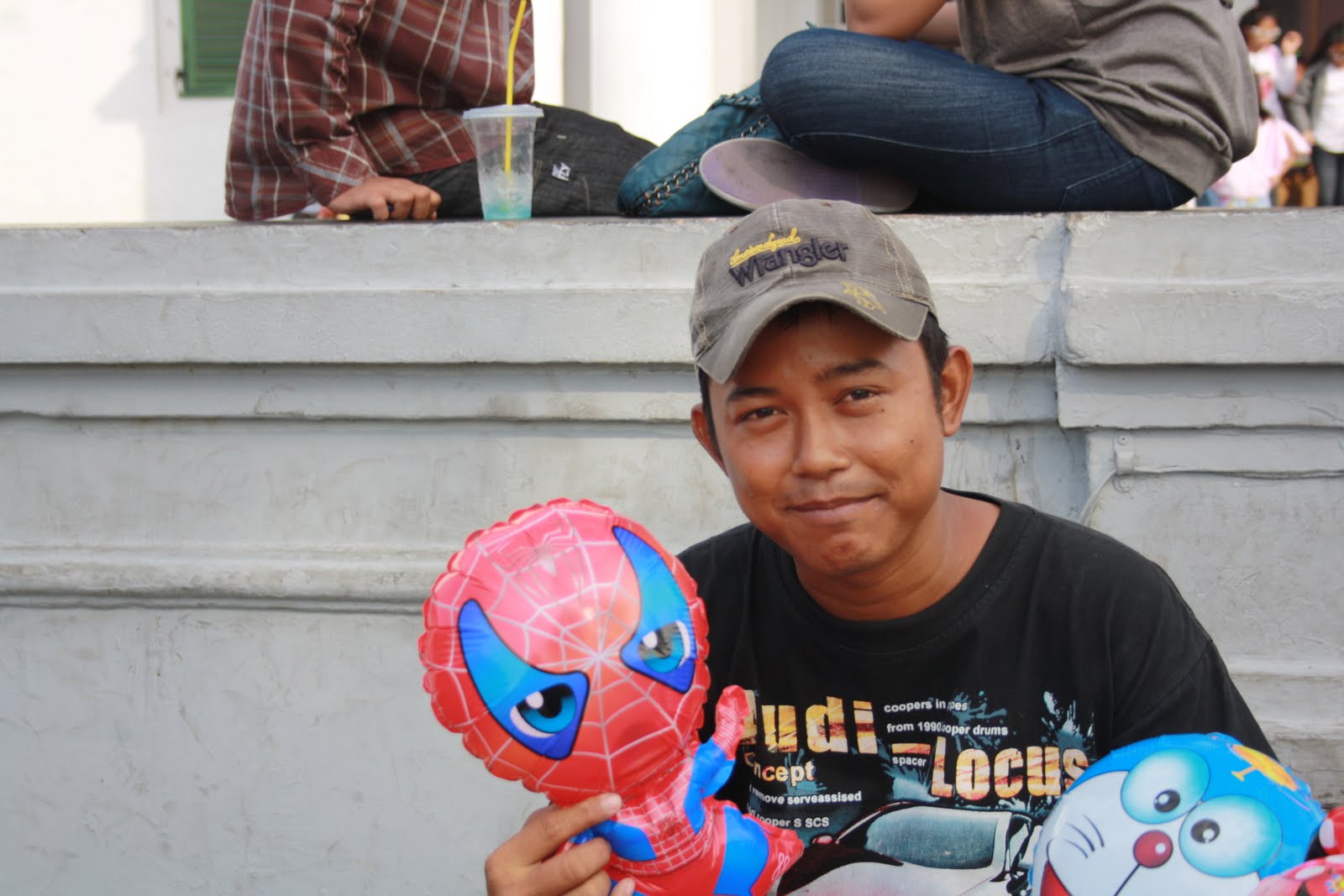
The most pleasant Bollywood-related experience I had occurred at the Tamah Fatiullah, a cobble-stoned square near thee Old Dutch Town Hall in the northern part of Jakarta. On a peaceful weekday afternoon, Agosh, a balloon seller approached me and asked me if I was from India. When I replied in the affirmative, he became excited and started singing Hindi songs and speaking to me in excellent Hindi.


Agosh
Within 5 minutes, we started singing the song 'Yeh Dosti' from Sholay. He told me about it was his greatest dream to visit Bombay and have street food on Chowpatty Beach. Agosh is still in school and I am sure that his dream will come true.

Wherever I went in Java, people told me about how much they love Shah Rukh Khan. Bollywood might just be a great way to bring these wonderful countries together again. The next time I go to Indonesia, I will carry many photos of Mr Khan to present to his adulating fans.

Monday, July 18, 2011

Yogyakarta

The heart and soul of Javanese culture can be found in Yogyakarta, which is an extremely pleasant place to spend a few months.

http://www.flickr.com/photos/7444188@N05/sets/72157627043719347/

Thursday, July 7, 2011

Sights of Jakarta

Indonesia's capital and largest city is a microcosm of the country. It offers the best and worst of the archipelago. Glitzy high-rises, heritage buildings and party zones go hand in hand with crowds, pollution and possibly the worst traffic jams on earth.

Although ignored by tourists, the city has plenty of offer to visitors.

http://www.flickr.com/photos/7444188@N05/sets/72157627012483705/